


What is Porsche Dynamic Chassis Control and How Does It Work?
Learn what Porsche Dynamic Chassis Control is and how its advanced stabilization technology transforms your driving experience today.
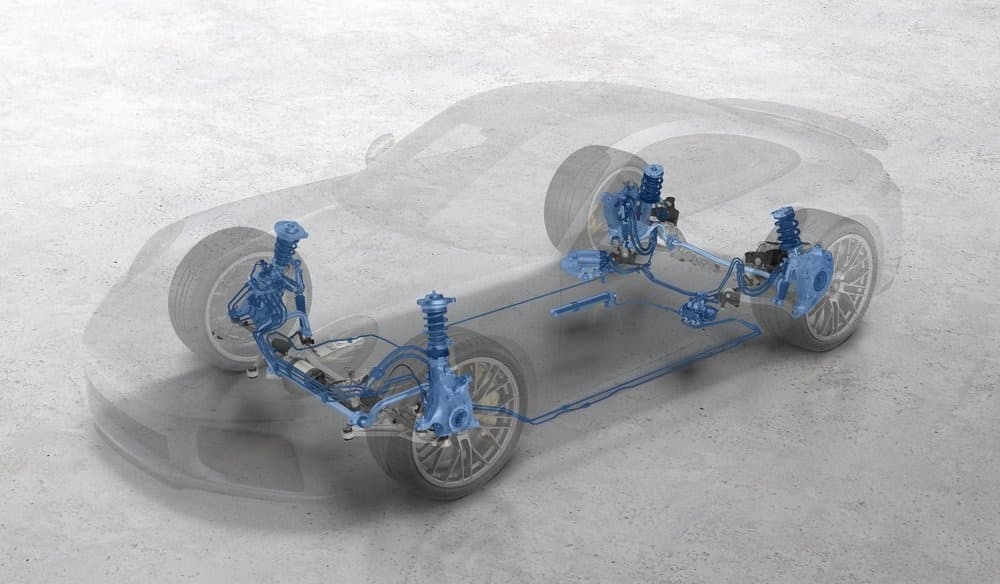
When you're carving through Livermore's winding roads or navigating the Bay Area's challenging terrain, your Porsche's ability to stay composed matters. Porsche Dynamic Chassis Control (PDCC) delivers that confidence by actively managing body roll before you even feel it. This technology creates a driving experience that adapts instantly to whatever Northern California throws at you.
At Porsche Livermore, we see firsthand how PDCC transforms the driving experience for our customers. Whether you're considering a Cayenne for family adventures or a 911 for weekend canyon runs, understanding what PDCC brings to the table helps you choose the right setup for your driving style.
What Is Porsche Dynamic Chassis Control?
PDCC is an active suspension technology that reduces body roll during cornering while maintaining comfort on everyday roads. Unlike traditional anti-roll bars that remain fixed, PDCC uses electronically controlled actuators to adjust stiffness in real time based on driving conditions.
The system constantly monitors how your Porsche moves through corners, over bumps, and during acceleration or braking. When sensors detect lateral forces building during a turn, PDCC counteracts that movement by stiffening the anti-roll bars. The result is immediate: your vehicle stays flatter through corners, maintaining better tire contact with the road surface.
What makes PDCC particularly impressive is its dual personality. During spirited driving, it delivers the flat, stable cornering you expect from a performance vehicle. But when you're cruising on the highway or navigating uneven pavement, the system softens to provide comfortable ride quality without sacrificing the composed feel Porsche is known for.
This adaptive approach means PDCC responds intelligently to your driving needs, whether you're attacking curves on Mount Hamilton or commuting through city traffic.
How Active Roll Stabilization Works
Active roll stabilization forms the core of what makes PDCC effective. Traditional anti-roll bars connect the left and right sides of your suspension, resisting body lean through mechanical stiffness. PDCC takes this concept further by replacing those fixed links with actuators that can adjust their resistance hundreds of times per second.
When you enter a corner, weight transfers to the outside wheels. PDCC detects this shift through its sensor network and immediately stiffens the appropriate side of the suspension, counteracting the rolling force and keeping your Porsche level with all four tires evenly loaded on the road surface.
The system only activates when needed, allowing the suspension to remain soft and compliant when you're driving straight or on smooth surfaces. This selective stiffness gives you performance when you want it and comfort when you need it.
The Key Components Behind PDCC
Three main elements work together to make PDCC function seamlessly. First, the actuators themselves replace traditional anti-roll bar links. Depending on your Porsche model, these may be hydraulic cylinders or electromechanical units. The Cayenne evolved from hydraulic actuators to electromechanical systems in newer models, while the Panamera and Taycan use electromechanical anti-roll bars as part of their PDCC Sport configuration.
Second, a network of sensors continuously feeds data to the control system. These sensors track steering angle, lateral acceleration, vehicle speed, and body movements caused by acceleration, braking, cornering, or rough road surfaces. Every input gets processed to build a complete picture of how your Porsche is moving.
Third, the central control unit takes all that sensor data and makes split-second decisions about how stiff the anti-roll bars should be at any given moment. This control system coordinates with other chassis technologies like Porsche Active Suspension Management (PASM) to create a unified response that optimizes both handling and comfort.
In the 911, PDCC uses a hydraulic cylinder system positioned directly on the wheel suspensions. Select models, including the 911 Turbo with PDCC Sport, benefit from this precise placement that allows for immediate response to cornering forces. The Cayenne's system integrates into its larger SUV platform, providing stability even with a higher center of gravity. The Panamera and Taycan deploy PDCC Sport with electromechanical technology that responds in just 200 milliseconds.
Real-Time Response to Road Conditions
The speed at which PDCC reacts separates it from older suspension technologies. When PDCC Sport's electromechanical bars detect the need for increased stiffness, they respond in 200 milliseconds. That's about twice as fast as you can blink, meaning the system is already stabilizing your Porsche before you feel any significant body roll.
This near-instantaneous response comes from the sophisticated sensor array that predicts what's about to happen rather than simply reacting to it. When you turn the steering wheel, PDCC doesn't wait for the body to start rolling; it reads your input and preemptively stiffens the suspension. The result feels intuitive, as if the car anticipated your intentions.
Beyond cornering, PDCC also responds to uneven road surfaces. When one wheel encounters a bump or dip, the system adjusts to prevent that irregularity from disrupting the entire chassis. This capability proves especially valuable on Northern California's varied terrain, where smooth highway can suddenly transition to rough pavement.
Driving Benefits You'll Feel on Northern California Roads
Northern California offers some of the most diverse driving conditions you'll encounter anywhere. From the technical curves of Skyline Boulevard to the elevation changes through Tri-Valley's hills, our local roads demand a suspension that can handle constant variation. PDCC excels in this environment by adapting to each challenge as it appears.
We often take customers on test drives through Livermore's surrounding areas to demonstrate PDCC's capabilities. The difference becomes apparent within the first few turns: your Porsche stays remarkably flat even when you're carrying significant speed through corners. That stability translates to confidence, allowing you to explore your vehicle's handling limits safely.
Confident Cornering Through Curves
The most noticeable benefit of PDCC reveals itself in corners. Body roll that would normally push you toward the outside of your seat gets minimized, keeping you and your passengers comfortably centered. More importantly, your tires maintain optimal contact with the road surface, maximizing grip and giving you precise control over your line through the corner.
This flat cornering feel transforms how you approach winding roads. Instead of managing body roll by adjusting your speed or line, you can focus purely on driving. The Porsche responds more predictably to steering inputs because the chassis isn't fighting against lateral weight transfer. That predictability builds trust, allowing you to push harder when the situation calls for it.
For Bay Area drivers who regularly navigate routes like Mines Road or Mount Diablo's scenic drive, PDCC turns technical sections into opportunities rather than obstacles. The system gives you the stability to maintain momentum through consecutive corners, creating a flowing driving experience that's both engaging and composed.
Everyday Comfort Without Compromise
Performance technology often comes with comfort trade-offs, but PDCC breaks that pattern. When you're not pushing hard through corners, the system softens to provide the supple ride quality you expect from a luxury vehicle. This adaptability means your Porsche doesn't punish you with harsh impacts over expansion joints or rough pavement during your daily commute.
The everyday comfort PDCC provides matters more than many shoppers initially realize. You're not always carving canyons; sometimes you're just picking up groceries or sitting in Bay Bridge traffic. PDCC ensures those mundane moments remain comfortable while keeping performance ready whenever you want it.
This balance particularly benefits families considering models like the Cayenne. Parents appreciate that PDCC can deliver thrilling handling on weekend drives while still providing a composed, comfortable ride for weekday school runs. The system doesn't require you to choose between sportiness and livability.
PDCC vs. PASM: Understanding the Difference
Many shoppers ask us about the relationship between PDCC and PASM. While both enhance chassis performance, they tackle different aspects of vehicle dynamics. Understanding these differences helps you appreciate how they work together to create Porsche's renowned handling.
Feature | PDCC | PASM |
Primary Function | Active anti-roll stabilization to reduce body lean in corners | Electronic shock absorber control for damping adjustment |
Key Benefit | Flatter cornering, better tire contact | Real-time ride adaptation to road and style |
Integration | Works with PASM for overall chassis control | Feeds data to 4D Chassis Control for synchronized response |
PDCC specifically manages roll stabilization by adjusting anti-roll bar stiffness. When you corner, PDCC counteracts the lateral forces trying to make your Porsche lean. PASM, on the other hand, controls the damping rate of your shock absorbers, determining how quickly they compress and extend over bumps or during weight transfer.
Think of it this way: PDCC keeps your Porsche flat in corners, while PASM ensures the ride quality remains appropriate for conditions and your selected driving mode. PASM continuously adjusts damping to match whether you're cruising smoothly or driving aggressively, feeding that information to systems like 4D Chassis Control for synchronized chassis response.
Many Porsche models offer both systems, and they complement each other beautifully. PASM provides the foundation of adaptive damping, while PDCC adds the active roll stabilization layer. Together, they create a comprehensive chassis management system that addresses both vertical and lateral dynamics.
Which Porsche Models Offer PDCC?
PDCC availability spans several models in the Porsche lineup, though implementation varies based on vehicle type and intended use. Understanding which models offer this technology helps narrow your search when configuring your ideal Porsche.
The Cayenne provides PDCC across various trim levels, using hydraulic actuators in earlier models and transitioning to electromechanical systems in newer iterations. Given the Cayenne's SUV proportions, PDCC delivers particular value by minimizing the body roll that higher vehicles typically exhibit during cornering. We see strong interest in PDCC-equipped Cayennes from customers who want confident handling without sacrificing the practicality and comfort expected from Porsche's SUV.
The Panamera offers PDCC Sport with electromechanical anti-roll bars, befitting its sports sedan positioning. This system enhances the Panamera's already impressive handling dynamics, keeping the larger four-door sedan remarkably flat through corners while maintaining its luxurious ride quality. The 200-millisecond response time means the Panamera reacts to your inputs with sports car immediacy.
Porsche's electric Taycan also features PDCC Sport as an available option. Despite the Taycan's battery weight positioned low in the chassis, PDCC adds another layer of handling precision. The electromechanical system integrates seamlessly with the Taycan's advanced electronics, creating a chassis that feels nimble despite the vehicle's substantial mass.
Select 911 models, including the 911 Turbo with PDCC Sport, employ a hydraulic cylinder system positioned directly on the wheel suspensions. This placement allows for immediate response to the dynamic cornering forces sports cars generate. For drivers who regularly track their 911 or pursue spirited driving on demanding roads, PDCC represents a significant handling enhancement.
PDCC availability and specifications vary by model year and trim level, so we recommend discussing your specific interests with our team at Porsche Livermore. We can walk you through current inventory and help you understand how PDCC fits into your desired configuration.
Experience Porsche Dynamic Chassis Control at Porsche Livermore
Reading about chassis technology only tells part of the story. PDCC's real impact reveals itself when you feel how it transforms your Porsche's behavior on real roads. We invite you to experience this technology firsthand with a test drive through Livermore's diverse terrain.
Our knowledgeable team at Porsche Livermore can help you explore models equipped with PDCC and explain how this technology integrates with your driving preferences. We understand Northern California's roads because we drive them daily, and we can guide you to the configuration that best matches your needs.
Contact us to schedule your test drive at our Livermore dealership and discover how PDCC enhances both performance and comfort. Start your Porsche journey today.